For soroban teachers — the app that makes what happens outside the lesson visible
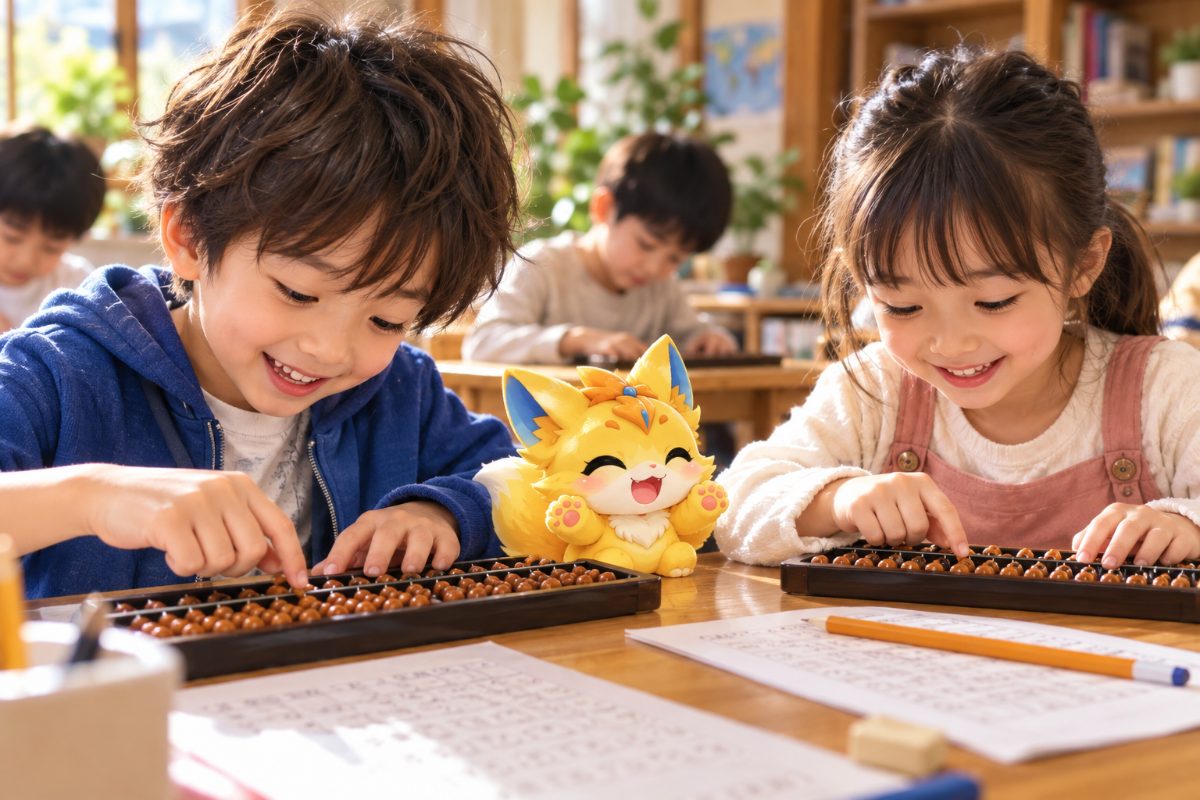
Between lessons two or three times a week, you cannot see how a student is practicing at home. Soroban Kingdom is the app that fills that gap. It fits teaching with a real soroban exactly as it is, and when you get one wrong, the bead move that most likely went wrong (worked out from the answer) is shown in a diagram. A school plan covers what students use at home (families pay nothing extra).
- Try the teacher screen first — free for 14 days, no credit card, up to 10 students. Open the teacher screen
- If you want to continue, choose a plan — see pricing ▼
How Soroban Kingdom helps teachers
| What you get | Why it matters |
|---|---|
| 🇯🇵 The authentic Japanese method | Built on the Japanese soroban curriculum — kyu and dan levels, test formats and bead technique as taught in Japan, where the method comes from. |
| 🔍 Error-pattern diagnosis | From each wrong answer, works out the bead move that most likely went wrong (5-complements, 10-complements, carrying), per student. It is a clue for your next lesson, not a record of the student's hands. |
| 🎓 Certificates | Printable certificates in a Japanese-style design after passing the SK Test. Parents share them — free word of mouth for your school. |
| 🧩 Fits your curriculum | Choose the level system your school follows. Soroban Kingdom is a tool for your school, not a rival programme. |
| ⏱ Less work for teachers | Homework sent and graded automatically, and a daily list of students who need attention. |
Home practice and teacher monitoring, at a glance
| Who | Home practice | What the teacher sees | Best for |
|---|---|---|---|
| Students | Daily practice set by the app, homework sets from the teacher, flash anzan and mock tests (SK Test) — on any phone, tablet or PC. With a real soroban alongside, the child types only the answer. | Completion, accuracy and time per problem; for each wrong answer, the bead move that most likely went wrong (worked out from the answer); weak skills per student (5-complements, 10-complements, carrying, borrowing). | Abacus schools and mental arithmetic centres that teach with a real soroban and want to see what happens between lessons. |
| Teacher | Assign "this week: 7th Kyu mitori × 3 sets" in one tap; worksheets (A4 / US Letter) if you prefer paper. | A daily list of who needs attention, who is struggling and who is ready to move up; per-student history; whether each mistake habit is fading. | One teacher with 10–40 students, or a centre with several classes (Academy, up to 150). |
| Parents | Nothing to install; a weekly practice card on the child's device. | — (a school plan covers the home side; families pay nothing extra) | Families who want to see progress without a second app. |
Bead-level error tracking — worked out from the answer, not from watching the hands
Example: 4 + 3. The correct move on the ones rod is +5 −2 (set the upper 5-bead, take away two lower 1-beads) → 7. If a child answers 8, the most likely reason is that only one lower bead came off. Soroban Kingdom shows that move for each wrong answer: the rod (ones), the bead (one lower bead left on) and the friends-of-5 rule to review, as a diagram, per student.
It is an inference from the answer — "most likely", a clue for your next lesson — not a recording of the child's hands or a camera. That is why it works with a real soroban (the child types only the answer), with the on-screen soroban, and for mental arithmetic, where no bead can be seen at all. Over weeks it tells you whether a habit (5-complements, 10-complements, carrying, borrowing) is fading or not.
Mapping your centre's levels to Japanese kyu and dan
Japanese kyu and dan grades belong to exam bodies, and their formats differ: Nissho / Nichishuren from 10th Kyu up, Zenshuren from 15th Kyu up to 10th Dan, and separate anzan (mental arithmetic) grades. Soroban Kingdom's level table runs 20th Kyu → 1st Kyu → 10th Dan; from 15th Kyu up the formats (digits and number of terms) follow published Japanese exam samples, and the teacher screen can switch the table to a Nissho/Nichishuren-style, Zenshuren-style, Zenshugakuren anzan-style or UCMAS-style ladder. Soroban and anzan levels are kept separate. The app's levels are a practice guideline, not an official grade — only an exam body awards a kyu or dan. Formats per level: levels page · how to build one table for your centre: grading systems compared.
What you can use right now
🖨 Homework worksheets: pick a level and a subject and get as many test-format question sheets as you like, with answers. Every sheet is different.
🏅 Mock test (SK Test): a time limit per subject, marked all at once. More about this.
🔍 Likely bead mistakes, as diagrams: not just right or wrong — for each student, a diagram of where it most likely broke down (friends of 5, friends of 10, carrying, and so on), worked out from the answer.
✋ About finger movement: Thumb and index finger: when to use each with diagrams, right down to the reason. Parents can teach it at home.
⚡ Flash Anzan, mental math, today's practice: a routine that keeps the test menu going every day (mental math 3 min × 3 → multiplication → division → addition).
How a school can use it
| Where | How to use it |
|---|---|
| Homework | "This week: 5th Kyu addition, 3 sets" → students do it in the app. Worksheets work too. |
| In the lesson | Flash Anzan and time attacks on each child's own device. For online lessons it is faster than screen sharing. |
| Deciding on a promotion | Decided by looking at accuracy and time per level, and mistake habits. |
| Explaining it to parents | A weekly practice card and certificates. "My effort shows" — so they keep going. |
| Trial lessons and joining | Hand the app to a child who comes for a trial lesson. It says: this is a school where it is easy to keep going at home. |
The teacher screen for schools
The teacher screen is ready to use. Sign in (Google, email and more) → enter your name (1 minute; email and password also work) → create a class → enter the students' nicknames → print the login cards. Children just enter the code and pick their name.
Practice made visible per student, homework handed out and marked automatically, and a list of students to talk to (needs follow-up / struggling / ready to move up).
Students need a nickname only (we do not collect the child's real name or date of birth). The teacher registers the students, prints a login card for home, and hands it over. At home, a parent signs in with their account and enters the key from the card just once.
Guides for teachers
- Free printable: soroban mistake observation sheet (one page, 20 students, no sign-up)
- 7 things to check before paying for abacus class software
- Tracking 20 students' mistake types without a spreadsheet
- Moving homework from the workbook to a screen, keeping the real abacus
- Between lessons: seeing what students do at home
- A flash anzan progression that climbs without stalling
- How to read a child's mistakes · Homework that gets done · Grading systems compared
Pricing
Levels 20–16 are free forever — no sign-up. From 15th Kyu up: a school plan (Studio $149/month and up).
Try it free for 14 days — no credit card needed. It simply stops after 14 days. If you subscribe, billing starts that day.
| Plan | Monthly | Yearly (save 2 months) | Students |
|---|---|---|---|
| Trial (no credit card) | $0 for 14 days | — | up to 10 |
| Studio | $149 | $1,490 | up to 40 |
| Academy | $349 | $3,490 | up to 150 |
| Franchise | Contact us for multi-school pricing | 151+ | |
Prices are in US dollars. Sales tax or VAT may be added at checkout, depending on where you live. The first payment is taken on the day you subscribe, then automatically on the same date every month (every year for yearly plans). Cancel any time from the customer page: the plan stops at the next renewal date and you can keep using it until then. No pro-rated refunds.
A school plan includes everything your students use at home — families pay nothing extra. Studio works out at under $4 per student per month, less than a single lesson. Families who don't attend a school can use the Home plan ($29/month).
Subscribe
Pay by credit card through Stripe. Please use the same email address as your teacher screen; your plan is applied automatically within minutes (1 business day at the latest).
Cancel or change your credit card any time from the customer page. Legal notice (Japan) · Terms · Contact
Founding Partner schools
The first 20 schools outside Japan get the Studio plan for $99/month for 12 months ($149/month from the 13th month), plus a direct line to us. In return, please send us a short note once a month about what works and what doesn't. Before we mention your school as an example, we will always ask you first.
✉️ Apply or ask a questionEmail info@sorobankingdom.com with your school's name, country and number of students. We reply within 2–3 business days. Questions are welcome too.
Soroban Kingdom is an independent practice app developed in Japan. It is not affiliated with any abacus examination body or franchise, and works alongside any school's method.
Levels 20–16 are free forever — no sign-up. Try "🖨 Make a worksheet" and "🏅 SK Test" to see how it fits your classes. The teacher screen is free to try for 14 days (no credit card).
▶ Open Soroban KingdomFounding Partner applications here ▲